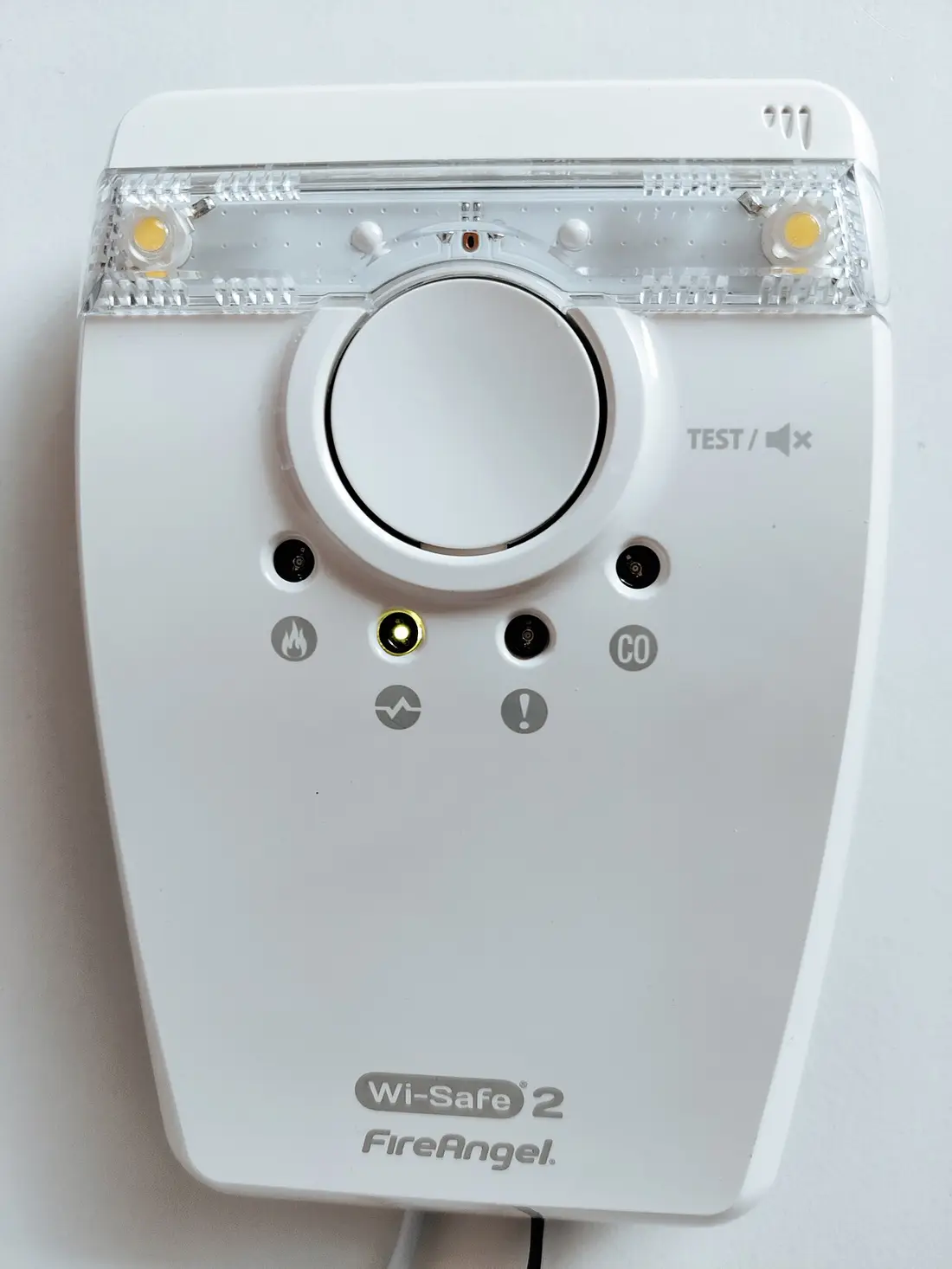
Detector sensors expire: smoke alarms are replaced at about ten years from manufacture, CO alarms commonly at five to seven - whether or not they still chirp reassuringly when tested.
Problem: Detector sensors expire: smoke alarms are replaced at about ten years from manufacture, CO alarms commonly at five to seven - whether or not they still chirp reassuringly when tested.
Solution: Placement follows the gases: smoke alarms in every bedroom, outside sleeping areas and on every level; CO alarms outside sleeping areas and on levels with fuel-burning appliances.
When to call: Interconnection is the system's multiplier - when one senses, all sound. Hardwired with battery backup is the standard; wireless interconnect serves homes where wiring cannot go.
Detectors fail in the manner opposite to every other appliance: silently, while appearing to work, on a schedule printed on their backs that nobody reads. The Oklahoma City housing stock makes the arithmetic pointed - whole subdivisions fitted with hardwired alarms in the same building month, now expiring in waves; older homes with a battery unit of mysterious vintage guarding the hall. This guide is the system's field manual: what the dates mean, where the units belong for smoke and for carbon monoxide, how interconnection multiplies their value, and the modest testing rhythm that keeps protection real instead of decorative.
The Oklahoma City Angle
The storm ledger is documented, not folklore. On May 3, 1999, an F5 tornado crossed Bridge Creek and Moore with winds measured above 300 miles per hour; on May 20, 2013, an EF5 crossed Newcastle and Moore on a similar path. Ice storms in December 2007 and October 2020 brought down lines and trees across the metro and left neighborhoods dark for days. Oklahoma also sits in one of the more lightning-active regions of the country. Surge damage, standby power and service-mast condition are standing topics here because the record made them so.
The Expiry Dates Nobody Reads
A smoke alarm's sensor is a consumable. The sensing chamber - ionization or photoelectric - degrades with dust, age and time until the unit's cheerful test beep certifies only that its buzzer works, not that it can still smell. Manufacturers and fire-safety practice therefore date them: smoke alarms are replaced at about ten years from the date of manufacture stamped on the back, carbon monoxide alarms sooner, commonly five to seven, because the electrochemical cell that sniffs CO tires faster. The end-of-life chirp that ignores fresh batteries is the device enforcing its own retirement - the last honest act of an expired sensor.
Read against the metro's housing history, the dates explain the waves: the subdivisions of the late 1990s and 2000s, fitted throughout with hardwired units at build, crossed their first replacement horizon together and are crossing their second now. Owners who have never replaced a detector in a twenty-year-old home are not lucky; they are overdue in a way that beeps occasionally at 3 a.m. and is otherwise invisible. The audit that dates a whole house takes one walk and a flashlight, and its result is a calendar - the first genuinely useful detector document most homes have ever had.
Placement: Where the Gases Actually Go
Smoke rises, pools at ceilings and travels the upper air from the fire's room toward the sleeping rooms, which is why placement is prescribed by geography: inside every bedroom, outside the sleeping areas in the immediate hall, and on every level including the basement -ceiling-mounted or high on walls, away from the dead-air corners where smoke arrives last. Kitchens get distance or a photoelectric sensor's temperament, because the alarm that cries wolf at toast is the alarm that gets its battery borrowed, and a detector disabled by annoyance protects no one.
Carbon monoxide writes different rules: it mixes with air rather than rising, it is produced by the house's own fuel-burning appliances - furnace, water heater, fireplace, the attached garage's morning warm-up - and it harms by accumulation during sleep. CO alarms therefore stand outside the sleeping areas and on every level, with the appliance zones inventoried at the same walk. Norman and Moore learned the season for it in every ice storm, when furnaces run for days and portable generators hum in driveways: winter is CO's high season, and the placement walk belongs in the calm months before it.
PROBLEM
→
SOLUTION
Interconnection and Power: The System's Character
A lone detector warns its room. An interconnected system - every unit sounding when any unit senses - warns the household, and the difference is measured in the geography of real fires: the basement's smolder against the third floor's sleepers, the garage's CO against the far bedroom. Hardwired interconnected alarms with battery backup are the standard new metro construction is built to, and the battery in them is the insurance against the outage - a relevant detail in a city whose detector emergencies and power failures share a weather system.
Where wiring cannot reasonably go - the finished historic house, the addition - wireless-interconnected units now deliver the same household chorus without opening walls, and quality sealed-battery units have retired the dead-battery failure for their decade of life. The honest plan mixes media by construction: hardwired where the house allows, wireless where it does not, all of it dated, mapped and tested as one system. What does not appear in any honest plan is the island: a single unit, of unknown age, guarding a hall outside one bedroom of three, whose test button nobody in the household has ever pressed.
The 3 A.M. Chirp: A Field Guide to Detector Sounds
Detector sounds are a small language worth fluency. The alarm itself needs no teaching. The single chirp at long intervals is a status report in two dialects - low battery and end of life - distinguishable by the unit's age and behavior after a battery change: a chirp that survives fresh batteries is the calendar speaking. The pattern of chirps varies by maker, but the grammar is universal: the device is reporting on itself, in the only voice it has, at the hour when the house is quietest - which is design, not malice, since 3 a.m. is when you are home to hear it.
The correct household protocol is short: never silence by removal, never borrow the battery, read the date on the back. The chirp is the simplest safety information your house produces, and the households that answer it promptly are the ones whose detectors, as a system, can be believed - because a system with one ignored voice teaches its owners to ignore all of them.
Rentals, Sales and Grandparents: The Detector File
Three events reliably expose a house's detector truth: the rental inspection, the home sale and the grandchild's first overnight. Each asks the same questions - are there units where they belong, are they in date, do they answer their test buttons - and each is easier with the file: installation dates, the placement map, test records. Landlords in this metro carry documented obligations for working detection; sellers discover that a dated, mapped, in-date system is a small but real asset at the inspection table.
The file also solves the inheritance problem: detectors outlive their installers' memory in the household, and the second owner of a home inherits units whose ages are written nowhere but on their backs. A house file that begins with the detector page - dates, map, test rhythm - hands the next household a system instead of an archeology project, which is, in the end, what this entire subject is asking for.
Myth vs Fact
The Myth
If the detector's light is on and it beeps when I press the button, it works - the dates are a sales tactic. Owners reasonably trust the evidence of their own test: noise came out, therefore protection is in force.
VS
The Fact
The test button proves the sounder, not the sensor - and the sensor is what expires. Sensing chambers and CO cells degrade on the manufacturer's clock whether or not the buzzer stays fit. The ten-year and shorter CO horizons are the fire-safety consensus, written from failure data. The date on the back is the only test of the part that matters.
The Related Service, In Depth
Detectors deserve their reputation as the least interesting and most consequential devices in the house: their entire virtue is exercised on the one night in a decade when they are needed, and their entire risk is that they age in silence toward that night. The management of that risk is calendrical, not technical - dates read, units replaced on schedule, placement redrawn when the house changes.
That is the service side of this guide's subject. When you are ready, the Smoke and CO Detectors page carries the process, the coverage by neighborhood and the number to call.
The Process, Step by Step
Date every unit
Off the wall or ladder-close: record each detector's manufacture date. The list is the system's truth and its replacement calendar in one.
Map against the floor plan
Bedrooms, halls, levels, appliance zones - mark what is missing, what is misplaced and what the kitchen keeps silencing.
Choose the system per zone
Hardwired interconnected where wiring serves, wireless interconnect where it cannot, sealed long-life units where maintenance is the weak point.
Test the chorus
One unit's test button must raise every unit in the house. The system's promise is verified, not assumed - then the dates go in the house file.
Prevention Checklist
Keep the detector dates in the house file and the replacement calendar with them; a system whose ages are known cannot expire by surprise.
Test monthly by button, and investigate any unit that fails its half of the ceremony that week, not that season.
Vacuum detector vents gently at the spring clean; dust is the sensor's slow enemy and the false alarm's friend.
When appliances are added, garages attached or bedrooms created, redraw the detector map in the same project.
Replace chirping end-of-life units immediately - the chirp means the sensor has retired, and the room it guarded is open until the new unit is up.
A Field Checklist for Your Own Home
Test every unit monthly; answer every chirp the same week by reading the date on the back.
Replace units at their printed horizons - ten years for smoke, sooner for CO as the maker states.
Keep one unit inside each bedroom, one outside the sleeping area, one on every level, and CO near the sleepers.
Run the chorus test after any change
one button, every unit sounding.
What the Paperwork Should Show
A detector plan visit walks the house room by room: dates read, placements graded against the sleeping map and the fuel-burning appliances, and a replacement or addition plan written with unit types chosen per location - photoelectric near kitchens, interconnect strategy set by the house's construction. Most plans complete in a single follow-up visit, hardwired where the ceilings allow and wireless-interconnected where they do not. Landlords receive the documentation their obligations require, in the file, dated.
Owners prepare by leaving the units reachable, noting any nuisance history honestly - the kitchen unit's complaints are placement data, not embarrassments - and keeping pets and children briefed that test day is loud by design. The chorus test is the visit's closing ceremony, and households that hear it once tend to keep the calendar that makes sure you hear it yearly.
How a Professional Works This Problem
A professional walks the house as the gases do: from the bedrooms outward, from the furnace room upward, reading manufacture dates with the floor plan in mind and grading placement against where smoke pools and CO accumulates. The plan that results is specific to the house's construction - hardwired where the ceilings allow, wireless interconnect where they do not - and it closes with the chorus test, one button raising every unit, and the calendar entered in the house file. The product is not detectors; it is a dated, mapped, verified system.
Mistakes That Make It Worse
Replacing the one chirping unit and leaving its nine siblings at the same expired age: They were installed together and they retire together.
Placing a CO alarm by the furnace and none by the bedrooms: The gas's target is the sleeper, and the placement follows the target.
Silencing the kitchen-adjacent alarm by removing it: Nuisance is a placement report; the answer is distance and sensor type, not an empty bracket.
Trusting the test beep as a sensor check
The beep certifies the buzzer. The calendar certifies the sensor. Only one of those is the protection.
The Bottom Line
Detection is the one system in this house that speaks for you when you cannot speak. Give it current sensors, true placements and a kept calendar, and the quietest system in the home becomes the one you can believe in the dark.
A GFCI watches for current leaking out of its proper path - through water or a person - and cuts power in a fraction of a second. It guards people, where a breaker guards wire.
A breaker that trips repeatedly is reporting one of three things - an overloaded circuit, a short or ground fault, or a breaker at the end of its own life - and each has a different remedy.
The detector came with the house. How do I know its age?
The manufacture date is printed on the back or the rim of every unit - twist it off its bracket or read it with a phone's flashlight on a ladder. Installation dates are not printed anywhere, which is why the manufacture date rules: a unit installed from old stock starts its life pre-aged. If no date can be found, treat the unit as expired; mystery is not a grade of protection.
Do I need both smoke and CO alarms, or are combination units fine?
Combination units are a legitimate answer where their placement can satisfy both gases' rules, and separate units give placement freedom where it cannot - CO near the sleeping areas and appliance zones, smoke on its own geography. The plan is drawn from your floor plan and appliance inventory, and many homes land on a mix. What matters is that both gases have their sentries posted by their own rules, not that the boxes match.
Why do fire departments say replace at ten years if the alarm still works?
Because 'works' at the test button proves the sounder and the circuit, not the sensor's sensitivity - and the sensor is the organ that ages. Fire data and manufacturer testing both show sensing reliability decaying across the decade until a unit can be slow to a real fire while remaining quick to burn toast. The date is the only test of the sensor a household has, which is why the calendar, not the beep, is the retirement rule.
My alarm keeps going off while cooking. Can it be moved?
Yes - placement and sensor type both have known answers for kitchen-adjacent alarms: distance from the cooking source, a photoelectric unit's calmer response to cooking aerosols, or a hush feature used as designed. What the nuisance alarm must not earn is removal or a borrowed battery, because nuisance is a placement report. The walk that fixes it takes minutes and restores a guardian the household had voted off the wall.
Please note: Oklahoma City Electrician is an independent directory and referral service, not an electrical contractor. The professionals reachable through this site are independent businesses; any agreement for work is between you and the professional you engage. Service information on this site is general educational material - the scope of any real electrical work is set by an on-site inspection.
A Breaker That Keeps Tripping, Lights That Flicker or a Panel Due for an Upgrade?
One call connects you with an electrical professional serving Oklahoma City and the surrounding metro communities - assessment, repair, service and installation.